
Since 2014
Ten Years of Reliability Your Trusted Partner
Ten Years of Reliability Your Trusted Partner
1. What is a inerlink trailer?
Key Features and Design
Advantages of Interlink Trailer
2. Common Types of interlink trailers?
3. How are interlink trailers connected?
4. How long is an interlink trailer?
5. How many tons is an interlink trailer?
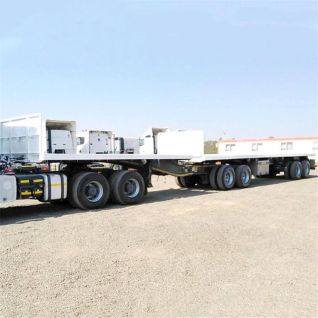
An interlink trailer for sale typically refers to a combined transport vehicle that connects two or more semi trailer sections together via a connecting device, and is simultaneously towed by a single tractor unit. Its core characteristic is "one tractor unit + multiple trailers connected in series," allowing it to transport more cargo at once compared to a standard single section semi trailer, thus making it suitable for bulk cargo and long distance transport.
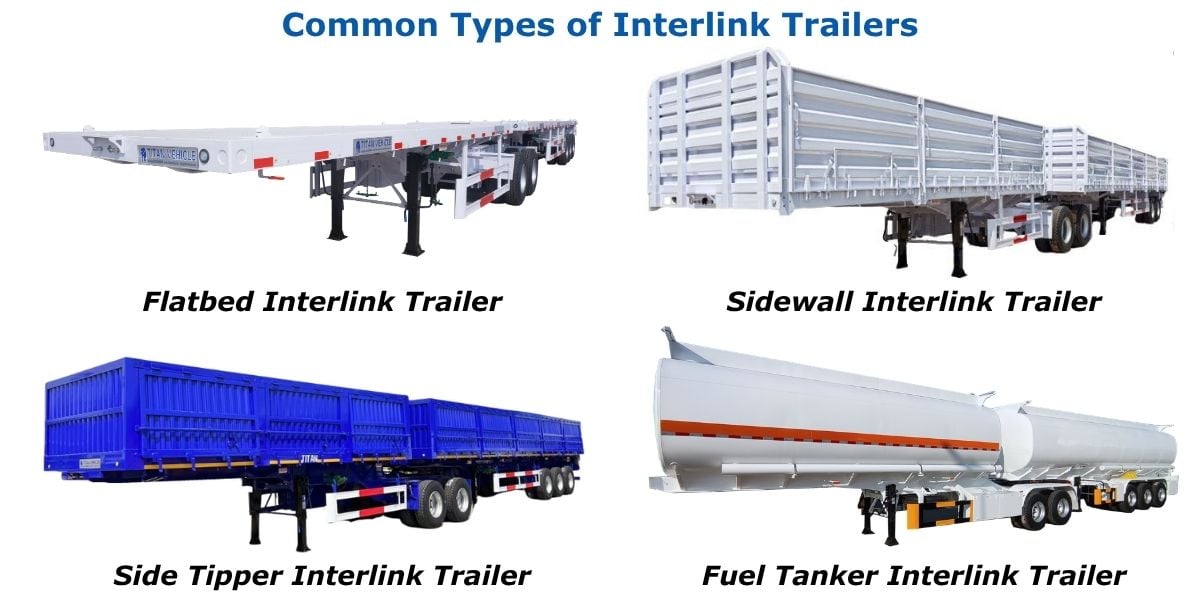
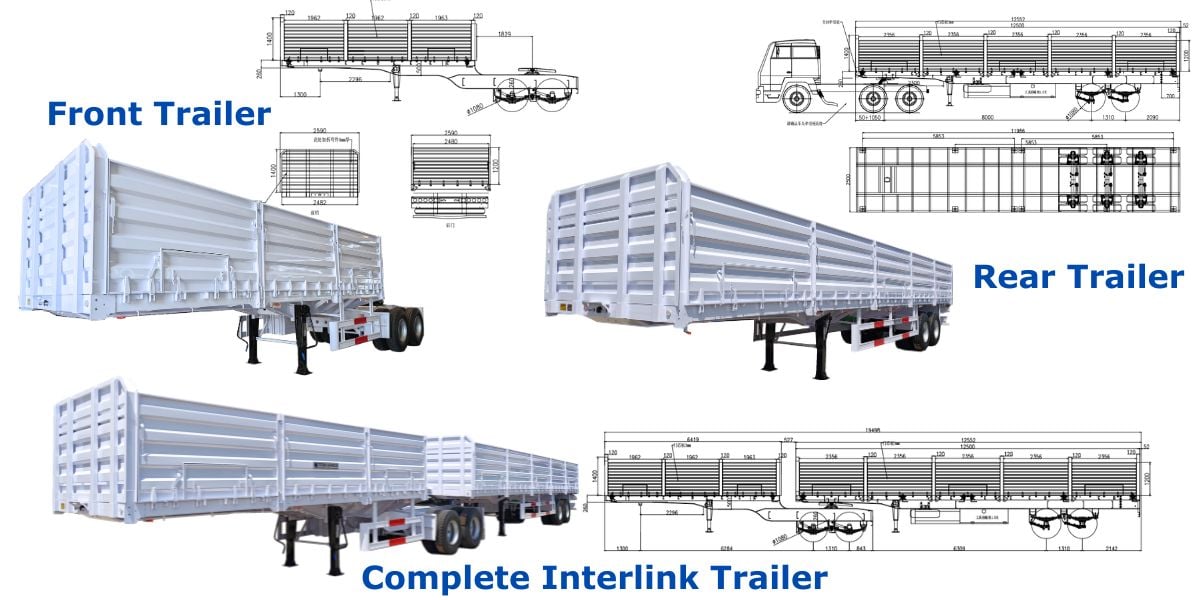
An interlink trailer for sale usually consists of a tractor unit, a front semi trailer, a connecting device, and a rear semi trailer. The front and rear trailers are connected by a drawbar, or a special connecting mechanism, forming a single unit. Depending on the transport requirements, different structures can be adopted, such as flatbed, dropside, side tipper, and fuel tanker types.
1. Interlink Design
The most obvious characteristic of interlink trailer for sale is their multi section design. They typically consist of a tractor unit, a front semi trailer, a connecting mechanism, and a rear semi trailer. The front semi trailer not only carries the cargo but also requires a dedicated rear connecting structure to provide a reliable traction connection for the second semi trailer. The connecting device needs sufficient strength while allowing for relative movement between the trailers during cornering, braking, and different road conditions.
2. High Strength Frame Design
Due to the typically large total weight and length of interlink trailer for sale, the frame needs high resistance to bending, torsion, and impact. The main beams are usually made of high strength steel and structurally reinforced according to the interlink trailer's total weight, axle load, and transport conditions. For models frequently transporting heavy cargo such as sand, ore, and steel, the longitudinal beams, cross beams, and suspension mounting areas can be reinforced to improve the reliability of long-term heavy-load transport.
3. Optimized Axle Arrangement Design
Interlink trailer for sale require a reasonable axle arrangement based on the total weight, cargo weight, and local road regulations. Both front and rear trailers can be equipped with corresponding axle groups, distributing the overall load across multiple axles and reducing the stress on individual bearings. For heavy duty transport, three axle, four axle, or even more axle designs can be used, giving the vehicle better load bearing capacity and driving stability.
4. Dedicated Connecting System
The connecting system is a crucial part of interlink trailer for sale design. The front and rear trailers are typically connected using a drawbar, draw pin, turntable, or other dedicated connecting mechanism. The connecting device must not only withstand longitudinal traction forces but also accommodate lateral and vertical movements generated during vehicle cornering. Therefore, the connecting structure requires thorough strength design and reliability testing.
5. Braking and Air System Design
Due to the significantly increased total mass of interlink trailer for sale, the braking system needs to be comprehensively matched. The braking signal from the tractor unit needs to be transmitted to both front and rear trailers, enabling coordinated braking across multiple axles. Simultaneously, brake air circuits and electrical wiring need to be connected between the front and rear trailers to ensure the proper functioning of lights, brakes, and other vehicle functions. A reliable braking system is particularly important for heavy duty and long distance transport.
6. Suspension System Design
Interlink trailer for sale typically require suspension systems with high load bearing capacity, such as mechanical or air suspension. Mechanical suspension is simple in structure, easy to maintain, and more suitable for engineering transport and harsh road conditions; air suspension offers better shock absorption, reducing impact on cargo and the chassis. The specific choice depends on the transported cargo, road conditions, and operating costs.
7. Steering and Vehicle Stability
Due to the greater overall length of interlink trailer for sale, turning trajectory, axle load distribution, and interlink trailer stability must be carefully considered during the design process. The coupling mechanism needs to allow for reasonable movement of the rear trailer during cornering, while axle positions, suspension parameters, and chassis dimensions also need to be matched to reduce lateral sway during cornering.
1. The biggest advantage of interlink trailer for sale is that they can connect two or more trailers together, all towed by a single tractor. Compared to ordinary single section semi trailers, interlink combinations increase the overall cargo loading space, allowing for the transport of more goods at once, while meeting local regulations and road conditions. This makes them ideal for transporting bulk goods such as grain, ore, sand, and building materials.
2. For long distance, high volume transport tasks, interlink trailer for sale reduce the number of round trips. Especially in ports, mining areas, logistics centers, and large scale engineering projects, more goods can be transferred in a single trip, thereby improving vehicle utilization and overall transport efficiency.
3. Interlink trailer for sale use one tractor to connect multiple trailers, which, under suitable operating conditions, reduces the need for a tractor and driver. For transport companies, this effectively reduces the unit cost of transporting goods, improving the economics of vehicle operation, especially with large transport volumes.
4. Interlink trailer for sale can be equipped with different trailer structures to suit different cargo. For example, it can be configured as a flatbed semi trailer, a sidewall semi trailer, a stake semi trailer, side tipper trailer, or tanker trailer. Different trailers can also be combined, allowing a single transport vehicle to adapt to various transport tasks.
5. Interlink trailer for sale is particularly suitable for long distance highway transport. By rationally designing the number of axles, axle load distribution, suspension system, and connecting mechanism, the overall stability of the vehicle can be improved, and the power of the tractor unit can be fully utilized to achieve higher transport efficiency.
6. In traditional transport modes, one tractor unit typically corresponds to one semi trailer, while in interlink mode, one tractor unit can undertake the transport tasks of multiple trailers. When the transport route is stable and the cargo volume is large, the power and transport capacity of the tractor unit can be fully utilized.
7. For the mining, port, agriculture, construction, and logistics industries, it is often necessary to transport large quantities of the same type of goods on fixed routes. Interlink trailer for sale can combine multiple transport units, making them more suitable for this high frequency, high volume, fixed route transport mode.
8. Interlink trailer for sale is not a fixed type of vehicle. Their overall length, number of axles, cargo box dimensions, suspension type, connection method, and load capacity can be customized according to the regulations, road conditions, and customer needs of different countries. Therefore, they have certain application value in Africa, Latin America, and other bulk cargo transportation markets.
1. Flatbed Interlink Trailer
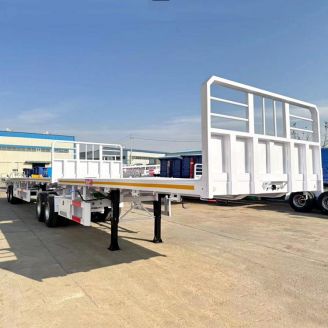
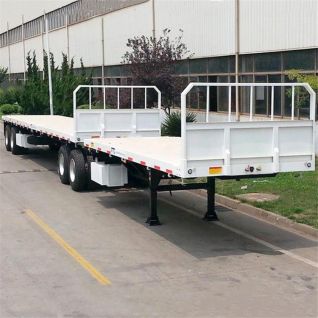
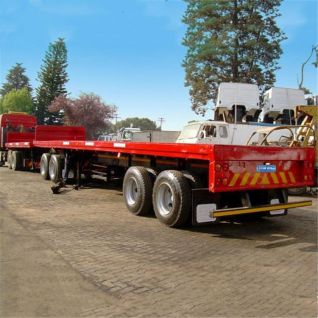
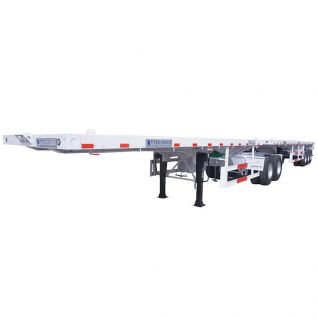
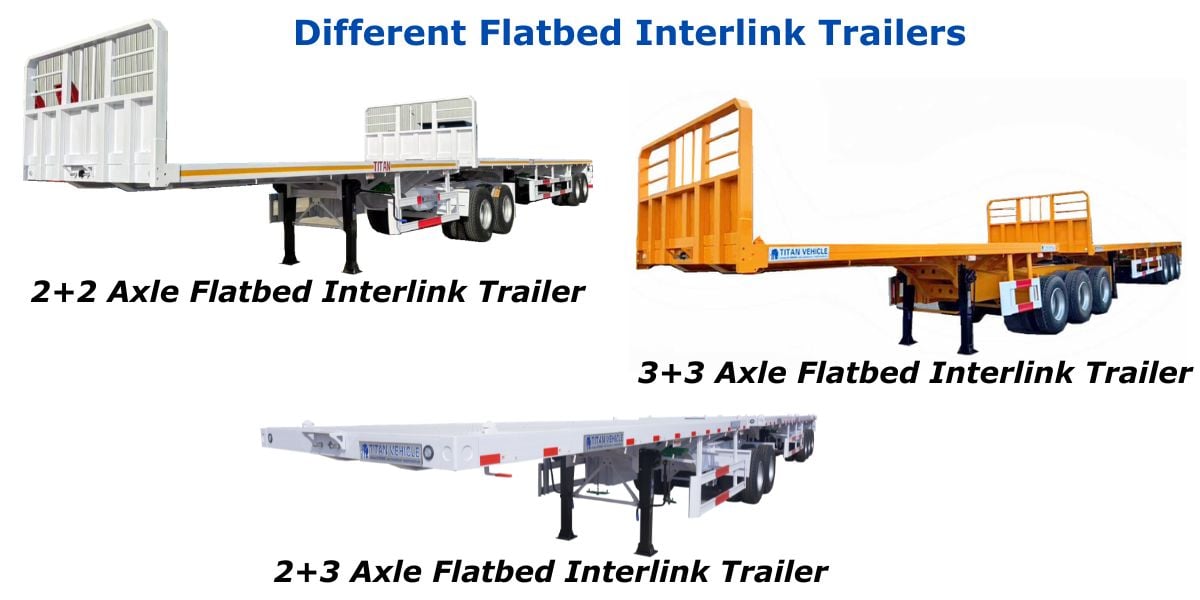
A flatbed interlink trailer for sale mainly consists of a flatbed trailer, a connecting device, and a rear flatbed trailer. The loading platform has no fixed cargo box, and its biggest advantage is its open loading space, making loading and unloading convenient. Flatbed interlink trailer for sale is ideal for transporting steel, timber, machinery, engineering equipment, containers, and other irregularly sized goods. In transportation scenarios where forklifts and cranes are commonly used, the flatbed structure allows for loading and unloading from the side, rear, or even top, offering high loading flexibility.
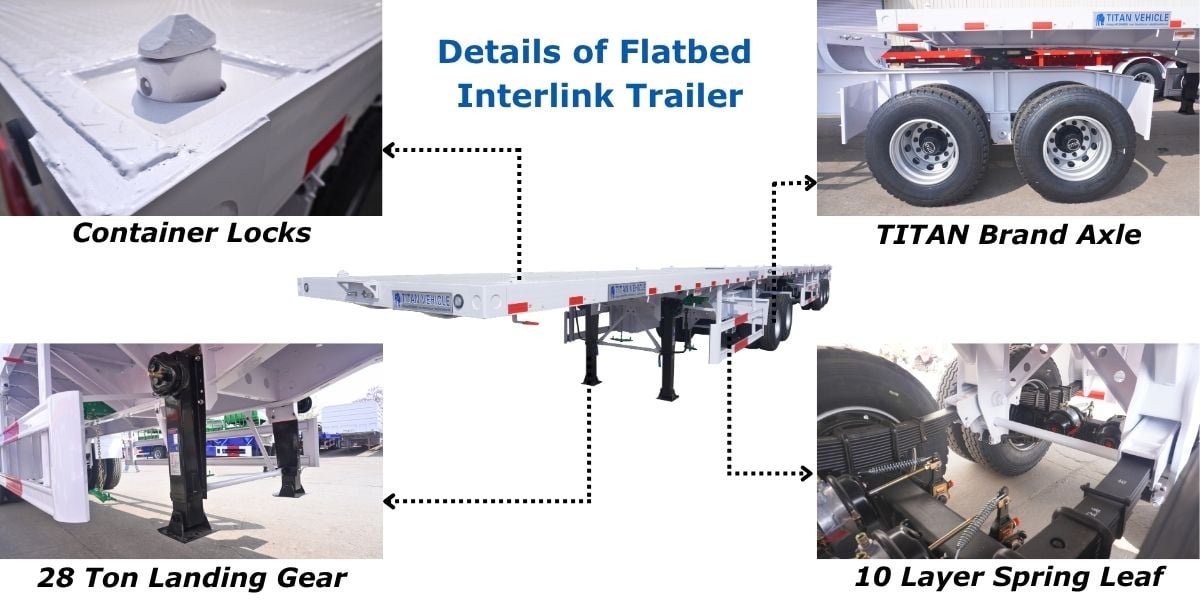
Flatbed interlink trailer for sale can also be designed in different lengths and axle configurations according to customer needs, and can be equipped with container locks, bollards, side rails, or front baffles to expand their application range. Flatbed interlink trailer for sale is more suitable for logistics transportation, port transportation, engineering equipment transportation, and bulk general cargo transportation. If customers transport a variety of goods and want one vehicle to handle multiple transportation tasks, a flatbed interlink trailer for sale is usually a more flexible choice.
2. Sidewall Interlink Trailer
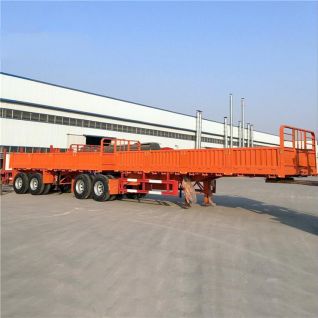
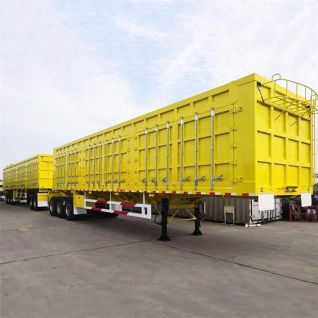
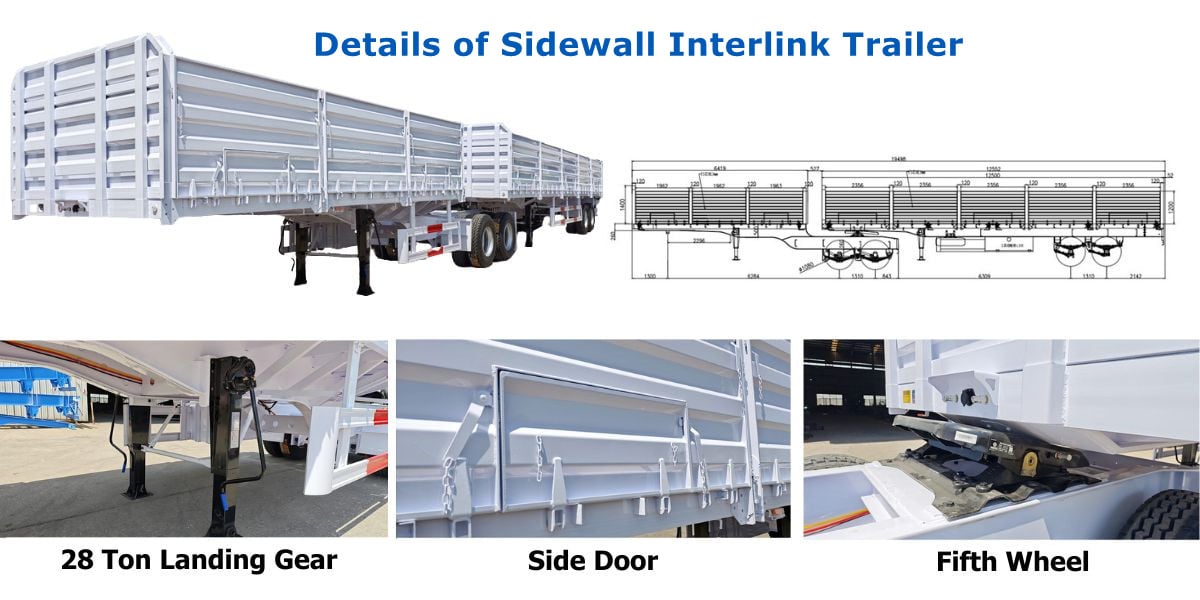
A sidewall interlink trailer for sale adds sideboards and front and rear baffles to a flatbed structure, thus providing better cargo protection compared to a pure flatbed model. Side walls prevent cargo from slipping to the sides during transport and can be used with tarpaulins to transport grain, agricultural products, bagged goods, building materials, and other bulk cargo.
This sidewall interlink trailer for sale is well-suited for the comprehensive freight market, especially for transport companies with a wide variety of goods. It can transport ordinary bagged goods as well as steel, timber, and machinery parts. If the side panels are tiltable or detachable, loading and unloading flexibility can be further improved. For customers who need to balance load capacity, applicability, and vehicle cost, the sidewall interlink trailer for sale offers good versatility.
3. Side Tipper Interlink Trailer
Side tipper interlink trailer for sale is mainly used for transporting bulk cargo such as sand, gravel, ore, coal, building materials, and earthwork. Compared to ordinary flatbed vehicles, its biggest feature is the hydraulic side tipping system, which tilts the cargo box to one side of the vehicle for quick unloading. For transport scenarios requiring frequent loading and unloading of bulk cargo, the side tipping structure significantly reduces manual operation time and improves vehicle turnaround efficiency.
Side tipper interlink trailer for sale is particularly suitable for mining areas, quarries, construction sites, road construction, and large scale earthwork projects. The interlink structure itself increases overall transport capacity, and combined with a hydraulic side tipping function, it achieves "large-capacity transport + rapid unloading." However, when tipping over, the vehicle places higher demands on site width, ground flatness, and stability; therefore, the design must focus on the cargo box's center of gravity, hydraulic system, frame strength, and axle load distribution.
3. Fuel Tanker Interlink Trailer
Fuel tanker interlink trailer for sale is mainly used to transport diesel, gasoline, aviation kerosene, and other liquid products that meet the vehicle and tank design requirements. They typically consist of two fuel tanker trailers and a dedicated connecting system. Compared to ordinary cargo interlink trailers, fuel tanker interlink trailer for sale has higher requirements for safety, tank strength, braking systems, and piping systems.
The main advantage of fuel tanker interlink trailer for sale is their greater capacity for transporting liquid cargo in a single trip, making them suitable for oil transportation companies, fuel distribution companies, and large scale energy logistics projects. The tank can be designed with different capacities and number of compartments according to transportation needs; for example, a multi compartment structure can transport different types or specifications of liquid products simultaneously. However, since fuel tanker interlink trailer for sale are special transportation equipment, their actual design and use must strictly comply with local regulations regarding tank bodies, dangerous goods transportation, vehicle gross weight, axle load, braking, grounding, and safety equipment.
| Type | Main Cargo | Key Advantages | Typical Applications |
|---|---|---|---|
| Flatbed Interlink Trailer | Steel, machinery, containers, equipment | Flexible loading and unloading; versatile for different cargo | Port logistics, general freight, equipment transportation |
| Sidewall Interlink Trailer | Grain, agricultural products, bagged goods, building materials | Good cargo protection; versatile for general transportation | General freight, bulk cargo transportation |
| Side Tipper Interlink Trailer | Sand, gravel, ore, coal, soil | Large loading capacity; fast hydraulic side tipping and unloading | Mining, quarrying, construction and road projects |
| Fuel Tanker Interlink Trailer | Diesel, gasoline and other liquid products | Large transport capacity; efficient liquid cargo transportation | Fuel distribution, petroleum transportation, energy logistics |
The biggest difference between an interlink trailer for sale and a regular semi trailer is that it's not just a single trailer; it connects two or more trailers end-to-end via a specialized coupling device to form a complete transport unit. The typical structure is: tractor unit + front semi trailer + coupling device + rear semi trailer. The tractor unit first connects to the front semi trailer via a saddle and a lead-ahead pin. A dedicated coupling mechanism is located at the rear of the front semi trailer to connect the second semi trailer. The rear semi trailer has a matching lead-ahead pin installed at its front. After connection, the tractor unit's power and braking forces are transmitted to the rear semi trailer through the front semi trailer and the coupling mechanism, allowing the entire vehicle unit to operate collaboratively. Interlink trailer for sale design allows for connecting more transport units with a single tractor unit, increasing overall transport capacity.
In practical design, the coupling device between the front and rear semi trailers is the core component of an interlink trailer for sale. The coupling device typically uses a reinforced lead frame, lead-ahead pin, lead-ahead seat, or other specialized mechanical connection mechanisms. The frame of the front trailer needs reinforcement in the connection area because the weight of the rear trailer, braking force, and impacts generated during vehicle movement are transmitted through this location. The connection mechanism cannot simply fix the two trailer sections together; it must allow for a certain degree of relative movement of the rear trailer when turning, going uphill or downhill, and traversing uneven surfaces. Therefore, a well-designed connection system must possess both sufficient load bearing strength and good mobility, which is crucial for interlink trailer for sale cornering stability and driving safety.
Besides the mechanical connection, interlink trailer for sale also require connections to the braking and electrical systems. When the tractor driver depresses the brake pedal, the braking signal needs to be transmitted sequentially to the front and rear semi trailers, ensuring that the braking systems of all trailers work in coordination. Typically, brake air lines, power lines, and lighting lines also need to be connected to ensure that the brake lights, turn signals, and side marker lights of the rear trailer function properly. For heavy duty interlink trailer for sale, brake system matching is particularly important because the combined weight of the vehicle is significant; if the front and rear trailers cannot brake in coordination, it can affect the vehicle's braking stability. Therefore, when designing interlink trailer for sale, it is necessary to comprehensively consider the vehicle's total weight, number of axles, braking system, suspension system, and local road regulations.
The connection structure of different types of interlink trailer for sale will also be adjusted according to the transportation purpose. Flatbed interlink trailer for sale usually focus more on the flexibility and load bearing capacity of the connection structure, as they may transport different goods such as steel, machinery, and containers; sidewall interlink trailer for sale need to consider the overall load when transporting general bulk cargo and large quantities of goods; side tipper interlink trailer for sale, in addition to bearing heavy loads, also need to pay special attention to the stability of the connection area and the vehicle's center of gravity during hydraulic tipping; and tanker interlink trailer for sale has even stricter connection requirements, requiring comprehensive consideration of tank structure, braking, stability, and the safety requirements for transporting liquid cargo. Therefore, a single connection mechanism cannot be simply used; instead, it needs to be specially designed according to the vehicle type and actual working conditions.
There isn't a fixed standard for the length of an interlink trailer for sale, as it typically consists of a front trailer, a rear trailer, and an intermediate connecting mechanism. Taking a 20FT + 40FT flatbed interlink trailer for sale as an example, the front trailer uses a 20 foot flatbed structure, and the rear trailer uses a 40 foot flatbed structure. The standard container length corresponding to 20FT is approximately 6.1 meters, and the standard container length corresponding to 40FT is approximately 12.2 meters. Therefore, the effective length of the two loading platforms combined is approximately 18.3 meters. However, it's important to note that 18.3 meters is only the sum of the cargo loading lengths of the 20FT and 40FT trailers, not the actual total length of the entire interlink trailer for sale. Because a dedicated towing connection device, a drawbar, and necessary turning and maneuvering space are required between the two trailers, the actual length after connecting the two trailers is usually longer than 18.3 meters. Based on common structural designs, the actual length of an interlink trailer for sale with a 20FT front trailer and a 40FT rear trailer combined can be roughly understood as approximately 19–21 meters. The specific dimensions will need to be determined based on the manufacturer's design and local regulations.
The position of the axle assembly also affects the overall length. Interlink trailer for sale require consideration not only of the vehicle length but also the proper arrangement of the axle positions of the front and rear trailers. The axle assembly position affects the vehicle's axle load distribution, load center, turning trajectory, and overall stability. If the axle arrangement is unreasonable, even if the cargo platform length meets requirements, problems such as excessive axle load, difficulty turning, or decreased vehicle stability may occur. Therefore, in actual design, manufacturers need to determine the axle position based on the gross vehicle weight, cargo weight, platform length, and local axle load regulations. This is especially important for heavy duty interlink trailer for sale.
There is no fixed, standardized load capacity for interlink trailer for sale. It primarily depends on the number of axles on the front and rear trailers, the frame structure, the suspension system, tire specifications, the gross vehicle weight, and the road regulations of the country of operation. Because interlink trailer for sale consist of a front trailer and a rear trailer, their overall load capacity is generally higher than that of a standard single section semi trailer.
The load distribution between the front and rear trailers is also crucial. An interlink trailer for sale is not simply a matter of adding the rated load capacities of the front and rear trailers. For example, if the front trailer is designed to carry 20 tons and the rear trailer 40 tons, it doesn't mean the entire interlink trailer for sale can legally carry 60 tons of cargo. The actual load capacity must also consider the tractor's saddle load capacity, the axle loads of the front and rear trailers, the load capacity of the intermediate connecting device, and the total interlink trailer weight. Therefore, it is necessary to rationally determine the cargo's center of gravity and the axle load distribution between the front and rear trailers to maintain the stability of the entire interlink trailer for sale.
From a product design perspective, the number of axles is one of the most important factors affecting the load capacity of an interlink trailer for sale. For example, a 2 axle front trailer and a 3 axle rear trailer create a relatively common multi-axle configuration. If transporting heavier engineering equipment, steel, or mining equipment is required, the number of axles in the front and rear trailers can be increased, using a 3+3, 3+4, or even more axle design. Increasing the number of axles allows for a more rational distribution of cargo weight across multiple axles, reducing the load on each axle and improving the vehicle's load bearing capacity and driving stability.
The chassis structure also directly determines the load bearing capacity. If the interlink trailer for sale is mainly used for transporting general cargo, standard high strength steel and conventional longitudinal beam structures can be used. If it is mainly used for transporting heavy machinery, engineering equipment, and steel, then the main beams, crossbeams, suspension mounting locations, and front-to-rear connection areas typically need to be reinforced. The connection between the front and rear trailers, in particular, needs to withstand the traction, braking force, and road impacts of the rear trailer, and therefore cannot be designed simply according to the structure of a standard semi trailer.
Furthermore, the suspension and tires also affect the actual load bearing capacity. Heavy duty interlink trailer for sale require axles matched to the axle load, leaf springs or air suspension, and high-load-bearing capacity tires. If the rated load capacity of the axles, tires, and suspension system is insufficient, even if the chassis itself can withstand greater weight, it is not safe to overload.
Therefore, the load capacity of an interlink trailer for sale is actually a complete system parameter, not determined solely by the chassis.
1. What cargo can an interlink flatbed trailer transport?
An interlink flatbed trailer is suitable for transporting steel products, machinery, construction equipment, timber, containers, pipes, and other large or oversized general cargo. Its open platform provides flexible loading and unloading from the rear, side, or top, making it suitable for logistics companies and customers who transport different types of cargo.
2. Is an interlink trailer suitable for container transportation?
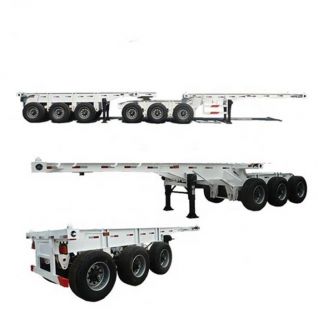
Yes. An interlink trailer can be designed with container twist locks for transporting standard containers. Depending on the configuration, it can be designed to transport 20FT, 40FT, and other standard containers. A 20FT + 40FT configuration is particularly suitable when the customer needs to transport different container sizes or larger quantities of containerized cargo.
3. Is an interlink trailer suitable for African markets?
Interlink trailers can be suitable for certain African markets where road conditions, freight demand, and local regulations allow this type of combination vehicle. They can be particularly useful for transporting agricultural products, construction materials, minerals, containers, and other bulk cargo. Before purchasing, customers should confirm the local regulations regarding overall vehicle length, gross weight, axle load, trailer combinations, and road access.
4. What determines the price of an interlink trailer?
The price depends on many factors, including trailer type, trailer length, axle quantity, payload capacity, chassis material, suspension system, tires, braking system, coupling system, hydraulic equipment, container locks, and optional accessories. A standard interlink flatbed trailer will generally have a different price from a heavy-duty Interlink Side Tipper or Fuel Tanker Trailer because of the differences in structure and equipment.
5. Can the interlink trailer be customized?
Yes. The trailer can be customized according to the customer's cargo and operating requirements. Customers can specify the front and rear trailer lengths, axle configuration, suspension type, cargo platform, side walls, container locks, tires, braking system, coupling equipment, and other components. The final design can also be adjusted according to the road regulations and transportation requirements of the destination country.
6. What should I consider before buying an interlink trailer?
Before purchasing an interlink trailer, customers should consider the type and weight of cargo, front and rear trailer dimensions, number of axles, total vehicle length, road conditions, tractor configuration, braking system, suspension type, and local legal requirements. It is especially important to confirm the permitted gross weight and maximum vehicle dimensions in the destination country before finalizing the trailer design.
Shandong TITAN Vehicle Co., Ltd.
Wehcat/Whatsapp: +86 18660159635
Tel.: +86531-88997626

BOSS WeChat

Boss Whatsapp